What lowers ApoB, sized
On this page
Halving the saturated fat you eat took ApoB down about 6 to 7 mg/dL in four weeks. Beans, lentils, nuts and soy in place of meat took off about 3 to 4, psyllium about 5 and oats about 3. Medicine that lowers LDL takes off about a third, on average.
What we’d do
Start with saturated fat and the protein swap, since they’re the two biggest food changes anyone has measured for ApoB. Count chicken with beef, because it raised ApoB just as much. Add psyllium or oats on top for the long run. Never add the numbers together and expect the total, and judge the result against the normal wobble between two tests. If your gap to your goal is more than about 20 points, start the food changes and book the doctor conversation at the same time.
If you remember three things
- Saturated fat first. About 14% of calories down to 7% took off 6 to 7 mg/dL, whatever the protein.
- Chicken counts as meat. Red and white meat raised ApoB the same. Plant protein took off 3 to 4.
- Every food change is smaller than one retest’s noise. Two tests can differ by about 15% with nothing changed.
Why the usual lists don’t help
Search for foods that lower cholesterol and you’ll get 20 of them, sized in LDL if they’re sized at all. ApoB is a different number, and the advice that people actually follow (lean chicken instead of steak, oatmeal for breakfast) turns out to be the weakest of it. The list below has each change measured in ApoB itself, from trials that tested it.
| Change | ApoB, about | From |
|---|---|---|
| Halve saturated fat, about 14% of calories to 7% | 6 to 7 mg/dL lower, about 10% | A feeding trial of 113 adults, 4 weeks per diet |
| Beans, lentils, nuts and soy as your main protein, in place of red or white meat | 3 to 4 lower | The same trial |
| Psyllium husk, about 10 g a day | 5 lower | 28 trials |
| Any soluble fiber supplement | 4.5 lower (2.7 to 6.3) | 181 trials, 14,505 people |
| Oats or barley, about 3.5 g of beta-glucan a day | 3 lower | 58 trials |
| Losing weight | No ApoB number yet | It lowers triglycerides, which travel in particles with ApoB on them |
| Less alcohol and sugar, if triglycerides are high | No ApoB number yet | It lowers triglycerides (cholesterol.guide has that plan) |
| Walking, cycling or swimming | No ApoB number yet | It raises HDL a little and lowers triglycerides |
These come from separate trials. Done together they usually add up to less than the sum, and nobody has measured how much less. Try your own number below.
How food changes the count
Your liver pulls ApoB particles out of the blood through receptors on its cells. How long a particle stays in circulation depends on how fast that clearing runs.
- Saturated fat slows the clearing. A 2005 review of how fats work found that saturated fats raise LDL by making more of it and by slowing how fast it’s cleared. Unsaturated fats, like olive oil, raise the number of receptors.
- Psyllium makes the liver pull harder. Its gel carries bile acids out of the gut. In a 1992 trial in 20 men, psyllium lowered LDL mainly by making the liver turn more cholesterol into bile, which leaves it short and pulling more particles in.
- Plant protein works even at the same fat. In the trial below, the plant diets had a little tropical oil added so their saturated fat matched the meat diets, and ApoB still came out 3 to 4 points lower. Why plants beat meat at the same fat isn’t settled.
The trial that sized it
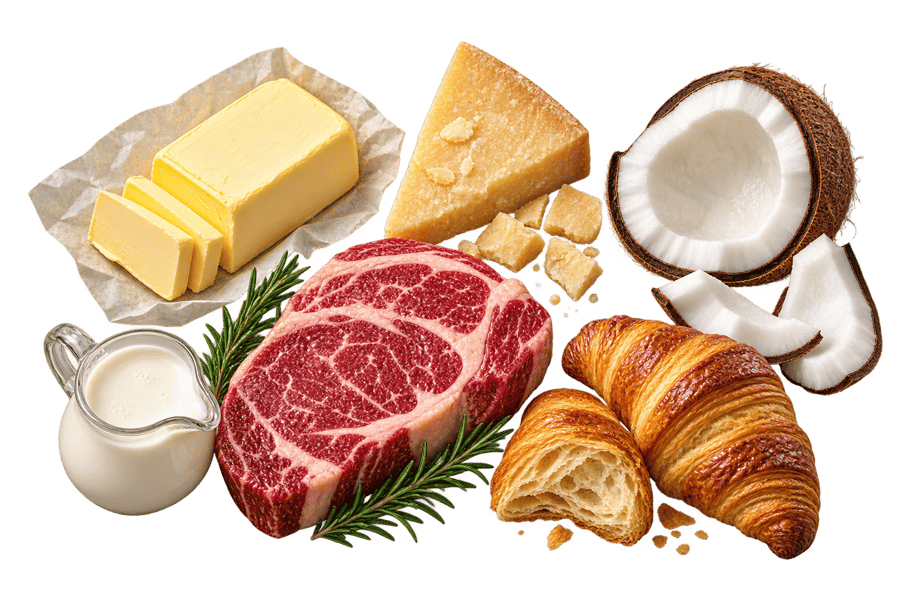
Nathalie Bergeron, Ronald Krauss and their colleagues at Children’s Hospital Oakland Research Institute ran the trial between 2012 and 2016. They put 113 healthy adults aged 21 to 65 on three diets for four weeks each, with nearly all their food provided. Protein came from red meat (mostly beef), white meat (chicken and turkey) or plants (beans, nuts, grains and soy), each about 12% of calories. Half the people ate about 14% of their calories as saturated fat, and half about 7%.
| ApoB, mg/dL | Red meat | White meat | Plants |
|---|---|---|---|
| High saturated fat | 73 | 74 | 70 |
| Low saturated fat | 67 | 67 | 63 |
Red and white meat came out the same, and the researchers wrote that the results “did not differ significantly between red and white meat”. Plants beat both by 3 to 4 points. Going from high to low saturated fat took off 6 to 7 on every protein. The meat was lean and unprocessed, and most of the extra saturated fat came from butter and full-fat dairy, so in practice the saturated fat cut is a butter and cheese cut. The chicken myth tells it in full.
Like a fuel-saving habit
Each of these is like a small fuel-saving habit on a car. Driving a little slower saves some, keeping the tires pumped saves some, and you can see it over a few months of fill-ups. On one tank you can’t tell it from the wind and the traffic. Food changes ApoB the same way, and the wind here is the normal test-to-test noise.
Fiber, sized
Psyllium husk, about 10 g a day, took ApoB down about 5 mg/dL across 28 trials of 1,924 people, and the reviewers rated that ApoB evidence high quality. Oat beta-glucan at about 3.5 g a day took off about 3 across 58 trials. Pooling 181 trials of soluble fiber supplements of every kind gave about 4.5 (2.7 to 6.3). The fiber myth is about why that’s real but hard to see.
The noise every change sits inside
Your ApoB varies about 6.4% from one draw to the next with nothing changed, in a study of lipid clinic patients sampled three times. The lab adds its own 5 to 6%. Together, a change has to pass about 15% before it’s probably real, and about 23% before it’s almost certainly real. At an ApoB of 112 that’s about 17 and 26 points. Every food change in the table is smaller than that, so you judge them over more than one retest, or with two draws a few days apart at each end (getting tested).
Medicine, for scale
Across 11 trials of LDL-lowering medicine, all of them built on a statin, ApoB fell 33% on average and LDL fell 42%. From an ApoB of 120, a third is about 40 points. Adding ezetimibe to a statin took ApoB down a further 15% in one large trial, and adding a PCSK9 antibody took it down more than 40%. These numbers are here for scale. Whether you take any of them is a decision for you and your prescriber (ApoB on a statin).
Fish oil isn’t on the list. The 2026 guideline recommends against supplements for lowering cholesterol, and says prescription omega-3 esters “can modestly raise LDL-C (but not apoB)”.
The fight: do food changes prevent heart attacks?
The food trials ran for weeks and measured ApoB. None of them counted heart attacks, and a skeptic is right to point that out. The case that a lower ApoB protects, whatever lowered it, comes from the gene study of 654,783 people, where the benefit per 10 points was the same whichever fat the genes lowered. We expect ApoB lowered by food to protect the same way per point, and your retest tells you whether yours fell.
11 sources
- Bergeron N, Chiu S, Williams PT, King SM, Krauss RM, red meat, white meat and plant protein on high and low saturated fat diets, a feeding trial in 113 adults, American Journal of Clinical Nutrition, 2019pmc.ncbi.nlm.nih.gov
- Jovanovski E and others, Effect of psyllium fiber on LDL cholesterol and alternative lipid targets, non-HDL cholesterol and apolipoprotein B, American Journal of Clinical Nutrition, 2018pubmed.ncbi.nlm.nih.gov
- Ho HV and others, The effect of oat beta-glucan on LDL-cholesterol, non-HDL-cholesterol and apoB for CVD risk reduction, British Journal of Nutrition, 2016pubmed.ncbi.nlm.nih.gov
- Ghavami A and others, Soluble fiber supplementation and serum lipid profile: a systematic review and dose-response meta-analysis of 181 randomized controlled trials, Advances in Nutrition, 2023pmc.ncbi.nlm.nih.gov
- Soffer DE, Marston NA, Maki KC and others, Role of apolipoprotein B in the clinical management of cardiovascular risk in adults: an Expert Clinical Consensus from the National Lipid Association, Journal of Clinical Lipidology, 2024pmc.ncbi.nlm.nih.gov
- Blumenthal RS, Morris PB, Gaudino M and others, 2026 ACC/AHA guideline on the management of dyslipidemia, JACC and Circulation, 13 March 2026doi.org
- The same guideline, full text, Circulation, 2026api.iscpcardio.org
- Fernandez ML, West KL, Mechanisms by which dietary fatty acids modulate plasma lipids, Journal of Nutrition, 2005pubmed.ncbi.nlm.nih.gov
- Everson GT, Daggy BP, McKinley C, Story JA, Effects of psyllium hydrophilic mucilloid on LDL-cholesterol and bile acid synthesis in hypercholesterolemic men, Journal of Lipid Research, 1992pubmed.ncbi.nlm.nih.gov
- Kafonek SD, Derby CA, Bachorik PS, Biological variability of lipoproteins and apolipoproteins in patients referred to a lipid clinic, Clinical Chemistry, 1992pubmed.ncbi.nlm.nih.gov
- Ference BA and others, Association of triglyceride-lowering LPL variants and LDL-C-lowering LDLR variants with risk of coronary heart disease, JAMA, 2019pmc.ncbi.nlm.nih.gov