Your arteries count particles
On this page
- The map
- Why count particles?
- How it works, in one picture
- When the two numbers split
- How many: your number against your goal
- How long: the years
- What lowers it, and by how much
- How to tell if it worked
- When it’s genes, medicine or a doctor
- What changed in 2026
- What nobody has proven yet
- Why are you here?
- The numbers in one table
- The simple plan
Every particle that can carry cholesterol into your artery walls has exactly one ApoB protein on it, so an ApoB test is a headcount. Plaque builds from how many of those particles you carry and how many years you carry them. Get the count under the goal for your risk, get there early and keep it there.
This guide is here so you can understand your number, do what you can about it with food, and know what to ask your doctor. It doesn’t diagnose anything, and it never tells you to start or stop a medicine.
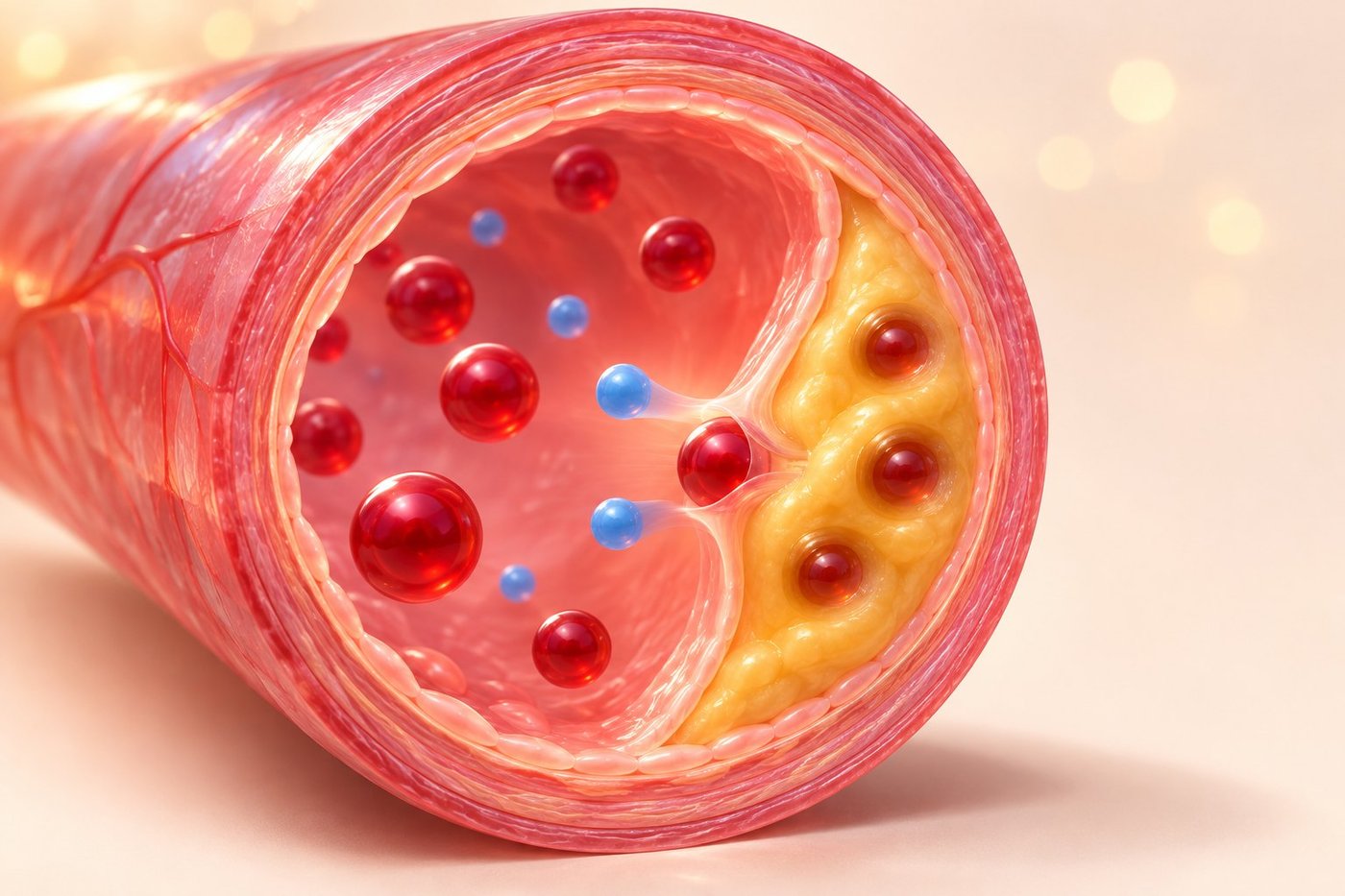
Did your doctor say your cholesterol looked fine? For most people that means an LDL inside its range, and an ApoB that nobody measured. The standard panel has four lines (total, LDL, HDL and triglycerides) and ApoB isn’t one of them. The National Lipid Association, the US society of cholesterol specialists, wrote in 2024 that the test is “underutilized”, even though it’s cheap to run and accurate.
The people who do get it tend to make two mistakes. They assume a normal LDL means a normal ApoB, since the two usually agree. And they check the range printed beside it, see no flag, and stop there. Both habits miss the same people, because the two numbers split most often in those with the most at stake: people with high triglycerides, diabetes, extra weight, or an LDL already brought down by a statin.
cholesterol.guide puts the big idea as LDL times years. LDL weighs the cholesterol the particles carry. ApoB counts the particles themselves, and the count is what the years act on.
What we’d do
Ask for ApoB with your next cholesterol test. You don’t need to fast. When it disagrees with your LDL, go by the ApoB, since the artery wall traps particles one at a time, however much cholesterol each one holds. Judge it against the goal for your risk. Half of untreated American adults are at 90 or more, and 90 is already the top of the goal for borderline risk.
If you want to and can, start the natural way, with food. Cut the saturated fat in butter, cheese and fatty meat, and get more of your protein from beans, lentils and tofu. Add fiber for the long run, but don’t expect it to show on one retest. At 140 or more, or if it stays over your goal on a statin, talk to your doctor, and never stop a medicine on your own.
The map
- What ApoB counts. One protein on each particle, and why that turns a blood test into a headcount.
- Why heart attacks follow the count. The genes, UK Biobank and the Copenhagen statin users.
- When ApoB and LDL disagree. The four corners, who lands where, and how much of it is the old LDL formula.
- What is a good ApoB level for my risk? Under 90, 70 or 60, and why the range on your report isn’t your goal.
- What lowers ApoB, sized. Each change in mg/dL from its own trial, and the twelve week plan.
- Getting tested, and telling a real change from noise. No fasting, the same lab, and where to get the test.
- Can I lower ApoB without medication? The size of your gap decides most of it.
- Should I take a statin for a high ApoB? The case for and against, and the questions to bring.
- ApoB on a statin. Why ApoB falls less than LDL once you’re on one.
- Why ApoB jumps around menopause. The year either side of the last period, and how to time your tests.
- What the 2026 guideline says about ApoB. The new lines, and the April study that followed.
Why count particles?
In 2019 Brian Ference and his colleagues looked at the genes of 654,783 people, 91,129 of whom had coronary heart disease. Some people are born with genes that lower their triglycerides (variants in a gene called LPL). Others are born with genes that lower their LDL cholesterol (variants in LDLR). Both kinds lower ApoB, but by very different routes, so the researchers could ask which part of the change protects the heart.
The answer was the count. For every 10 mg/dL lower ApoB, the odds of heart disease were 0.771 with the triglyceride genes and 0.773 with the LDL genes. That’s about 23% lower either way. The authors wrote that the benefit of lowering triglycerides or LDL “may be proportional to the absolute change in ApoB”. Genes are handed out at random before birth, so a study like this works like a trial that ran for a whole lifetime.
In 2022 Nicholas Marston’s team put ApoB, triglycerides and non-HDL cholesterol into one model for 429,959 people in UK Biobank. Once all three were in, only ApoB stayed tied to heart attacks, in people with heart disease and in people without it. The 2026 US guideline came to the same place. It says that when ApoB and LDL disagree, ApoB predicts heart disease more accurately. Why heart attacks follow the count has every study.
How it works, in one picture
Think of a highway. LDL cholesterol tells you how much cargo is on the road. ApoB counts the trucks. Usually more cargo means more trucks. But if each truck carries less, the same cargo needs more of them, and every truck is one more that can crash into the guardrail.
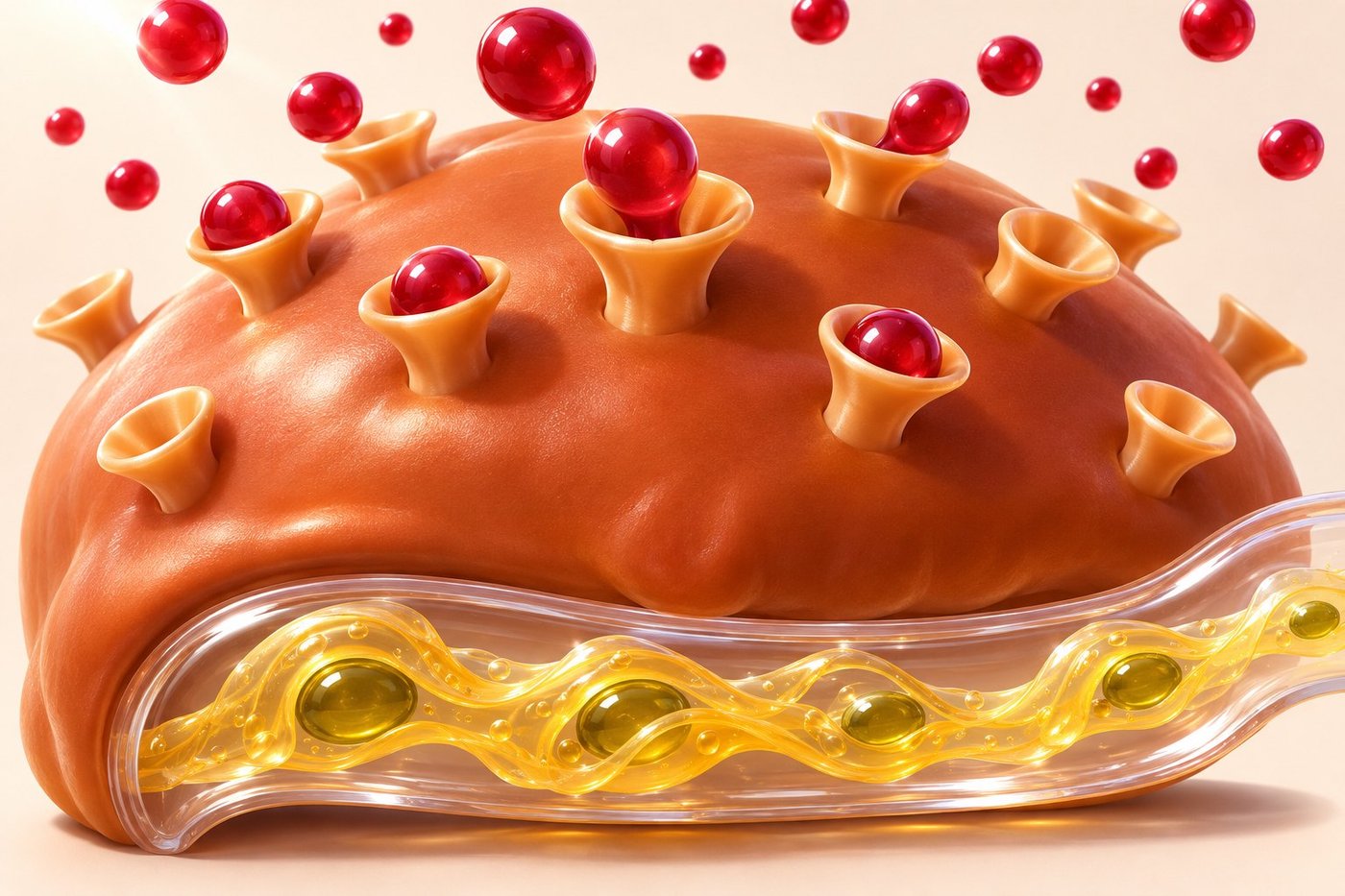
- Your liver makes the trucks. It sends out large particles called VLDL, loaded with triglycerides. As they drop that load around the body they shrink into LDL. Each one carries a single ApoB protein the whole way.
- Receptors take them off the road. Receptors on your liver grab the ApoB and pull the particle back out of the blood. Saturated fat slows this clearing, and that’s one reason it raises the count.
- Some get stuck in the artery wall. Particles slip into the wall, and ApoB’s strong electric charge helps trap them there. Trapped particles build plaque over years.
- More particles for more years means more get stuck. The number of particles is the number of chances, which is why the count predicts heart attacks better than the cargo.
In that UK Biobank study of 293,876 adults, the people with a high ApoB for their LDL had nearly twice the rate of new heart disease and strokes over 10 years as the people with a low one (7.3 against 4.0 in the paper), at the same LDL of about 130. What ApoB counts builds this out step by step.
When the two numbers split
For most people LDL and ApoB tell the same story. They split in a predictable set of people. High triglycerides, diabetes and extra weight push out more particles, each carrying less cholesterol, so the LDL looks better than the count. A statin lowers LDL more than ApoB, 42% against 33% on average across 11 trials, so LDL can reach its goal first. And part of the split comes from the old formula many labs use to work LDL out. With a newer one, only about 2% of people with an LDL under 70 had a non-HDL and ApoB over the goals.
A man with an LDL of 95 and an ApoB of 112 lands here. His LDL is at the 30th percentile of untreated US adults and his ApoB at the 79th, so he carries more particles than his LDL suggests.
In Copenhagen, 13,015 people on statins were followed for a median of 8 years. Those with a high ApoB and a low LDL had about 1.5 times the heart attacks of those with both low. When ApoB and LDL disagree has the four corners, and Do my ApoB and LDL agree? puts your own two numbers in one.
How many: your number against your goal
Your goal depends on your risk of a heart attack or stroke, which your lab doesn’t know. The National Lipid Association’s 2024 table matches ApoB to the 2026 guideline’s LDL goals: under 90 mg/dL (0.90 g/L) at borderline or intermediate risk, under 70 at high risk, and under 60 after a heart attack or stroke. At any risk, the guideline lists 120 or more as something that raises risk, and calls 140 or more severe.
- Under 60 very high risk
- Under 70 high risk
- Under 90 borderline or intermediate risk
- 120 raises risk
- 140 severe
mg/dL over g/L. Rungs from the National Lipid Association (2024), matched to the 2026 US guideline's LDL goals. Ticks from the 2026 guideline.
The surprise is that the middle untreated American adult has an ApoB of 90, right on the line for borderline risk, and fewer than 1 in 10 are under 60. A result in the middle of the pack is already at the top of a goal.
What is a good ApoB level for my risk? has the whole ladder, Is my ApoB high? holds your number against your goal, and How does my ApoB compare? lights your own bead.
How long: the years
ApoB creeps up about half a point a year through young adulthood, and nobody feels it. The 2026 guideline says that normal rise “should not be perceived as optimal”. A count that looks harmless at 25 has decades to add up.
CARDIA, a US study, started in 1985 with young adults aged 18 to 30. Among the 2,794 of them in this analysis, the ones with a high ApoB and a low LDL were more likely to have calcium in their heart arteries 25 years later (about 1.55 times the odds, after taking other risks into account). Their LDL looked fine the whole time.
The dashed line is what an ApoB of 90 adds up to by 60. At 120 you get there by 50, and at 70 not until about 71. It's arithmetic, the count times the years, and it isn't a risk score.
Nobody has found a total at which plaque suddenly appears, and the chart doesn’t claim one. It shows why a lower count buys you years, and why the earlier you lower it, the more years it buys. cholesterol.guide’s Why LDL is a lifetime number has the gene and trial evidence behind the years, and lifespan.guide puts heart health beside the other things that add them.
Women get a jump of their own. In SWAN, a US study that followed 1,054 women through menopause with a check every year, total cholesterol, LDL and ApoB were the only heart risk factors that jumped in the year either side of the last period. Why ApoB jumps around menopause has how to time your tests around it.
What lowers it, and by how much
The biggest food changes measured for ApoB come from one careful trial, published in 2019. Its 113 adults in Oakland, California ate three diets for four weeks each, with nearly all their food provided. Halving saturated fat, from about 14% of calories to about 7%, took ApoB down about 6 to 7 mg/dL. Getting protein from beans, nuts, grains and soy in place of meat took off about 3 to 4 more. Chicken raised it as much as beef did.
The pale band is about 17 points: how far two tests at 110 can land apart with nothing changed. Each food change sits inside it on one retest, so judge food over several. The changes overlap, so they never add up to the sum of the bars.
Fiber is smaller. Across 181 trials, soluble fiber took off about 4.5 mg/dL, and psyllium about 5 across 28. That’s real, and it adds up over years, but it’s less than the 15 or so points two tests can differ by with nothing changed. Medicine is in a different league. Across 11 trials of LDL-lowering medicine, ApoB fell 33% on average, which is about 40 points from 120.
What lowers ApoB, sized puts every change side by side, the twelve week plan turns them into a schedule, and What would lower my ApoB? runs them on your number. fats.guide goes deeper on saturated fat, and protein.guide on getting enough protein from plants.
How to tell if it worked
Your ApoB moves about 6.4% between tests with nothing changed, and the lab adds 5 to 6% of its own. Together that means a change has to pass about 15% before it’s probably real, and about 23% before you can be sure. At an ApoB of 100 that’s 15 and 23 points.
Two draws a few days apart at each end, averaged, bring those lines down to about 11% and 17%. ApoB didn’t change after a normal meal in 33,391 adults, so fasting doesn’t matter, but using the same lab does. Leave 6 to 12 weeks after a food change before you retest. Getting tested has the details, and Did my ApoB really change? stamps your own two results.
When it’s genes, medicine or a doctor
At 140 or more, the 2026 guideline calls it severe high cholesterol at any risk, looks for a cause and checks for an inherited form, so that’s a doctor visit before a diet plan. A parent, brother or sister with a heart attack or stroke young (men before 55, women before 65) is on the guideline’s list of things that raise risk. So is a high Lp(a), an inherited particle your ApoB already counts, one ApoB on each. Is high ApoB genetic? covers both, and cholesterol.guide’s When it’s your genes covers familial hypercholesterolemia.
Whether food alone can get you there comes down to the size of your gap and your risk. Can I lower ApoB without medication? sizes it, and Should I take a statin for a high ApoB? lays out the case for and against, with the questions to bring. If you already take one, ApoB on a statin explains why ApoB often lags behind LDL. Your prescriber decides any change.
What changed in 2026
On March 13, 2026, a new US cholesterol guideline lowered ApoB’s risk line from 130 to 120, named 140 as severe, and said testing ApoB is reasonable for people on treatment once their LDL goal is met. In April a Northwestern University computer model of 250,000 American adults found that treating to an ApoB goal prevented more heart attacks and strokes than treating to an LDL goal, at what the lead author called good value. What the 2026 guideline says about ApoB has each change.
What nobody has proven yet
No trial has given one group treatment aimed at an ApoB goal and another group treatment aimed at an LDL goal, and then counted heart attacks. The Northwestern study is a model, so it shows what should happen if the other studies are right.
The food trials have the same gap. They ran for weeks and measured ApoB, not heart attacks. We think a lower ApoB protects the same way whatever lowered it, because the genes in Ference’s study did exactly that, but the food trials themselves can’t show it.
Why are you here?
People come to ApoB for a lot of different reasons. A first result with no context, a normal LDL beside a high ApoB, a jump on keto, a statin that fixed the LDL but not the ApoB, a parent who had a heart attack young. Pick yours.
-
 My ApoB came back highWhat high means at your risk, and the 120 and 140 lines
-
 I want to get testedWhat to ask for, no fasting, and the home kit
-
 I want to lower it without medicineThe plan the trials ran, every change sized
-
 My LDL is normal but my ApoB is highMore particles, each carrying less
-
 Is my number normal?The lab’s range against the goal for your risk
-
 I heard the guidelines changedThe March 2026 lines and the Northwestern study
-
 My doctor brought up a statinThe case for and against, and what to ask
-
 Can I fix it with food alone?Your gap to your goal decides most of it
-

 My ApoB shot up on ketoWhy it happens and what the guideline says
-
 My LDL is at goal on a statin, but my ApoB isn’tWhy it lags, and the question for your prescriber
-
 It runs in my familyFH, Lp(a) and testing your relatives
-
 It went up around menopauseThe jump in the year around your last period
-
 I eat well, so why is it high?Eight taps name the most likely cause
-
 I’m fit, so why is it high?What exercise moves, and what it doesn’t
-
 I’m losing weight, or on a GLP-1What weight loss does, and when to retest
- It changed since my last testNoise, or something real
-
 I want the number for a long lifeUnder 60, and who it’s for
-
 I’ve had a heart attack or a stentThe lowest goal, under 60
-
 My Lp(a) is highYour ApoB already counts it
The numbers in one table
| The line | Why | |
|---|---|---|
| Goal at borderline or intermediate risk | Under 90 mg/dL (0.90 g/L) | The National Lipid Association’s number, matched to the 2026 US guideline’s LDL goal of under 100 |
| Goal at high risk | Under 70 (0.70) | Matched to LDL under 70 |
| Goal after a heart attack or stroke | Under 60 (0.60) | Matched to LDL under 55 |
| Raises risk | 120 or more (1.20) | On the 2026 guideline’s list of risk enhancers |
| Severe | 140 or more (1.40) | The guideline calls it severe high cholesterol. A doctor visit at any risk |
| The middle untreated US adult | 90 | NHANES 2005 to 2016, 12,696 adults. 120 is about the 86th percentile |
| A real change | About 15% is probably real, 23% almost certainly. With two draws at each end, 11% and 17% | Your body varies about 6.4% between tests and the lab about 5 to 6% |
| Fasting | Not needed | ApoB didn’t change after a normal meal in 33,391 adults |
The simple plan
For anyone who wants healthy arteries, in plain steps.
- Test. Ask for ApoB with your next cholesterol panel, or use a kit you take at home and mail back. At a lab you don’t need to fast for it. Where to get an ApoB test.
- Know your goal. Ask your doctor which risk band you’re in. Under 90 at borderline or intermediate risk, under 70 at high risk, under 60 after a heart attack or stroke. At 140 or more, see a doctor before you plan anything else. Is my ApoB high?
- Check it against your LDL. If the two disagree, go by the ApoB. Do my ApoB and LDL agree?
- Lower it the natural way first, if you want to and can. Cut the saturated fat in butter, cheese and fatty meat, and get more of your protein from beans, lentils, nuts and soy, with chicken counted as meat. Add psyllium or oats for the long run. The twelve week plan.
- Retest at the same lab in 6 to 12 weeks. A change has to pass about 15% before it’s probably real. Did my ApoB really change?
- Get help when the gap is big. If you’re more than about 20 points over your goal, or in a group the guideline offers a statin to, take both numbers and your questions to your doctor, and keep the food changes. Never stop a medicine on your own. The case for and against.
- Keep it there, and keep every result. Test ApoB with each cholesterol panel, write down the date and the lab, and watch the line over the years more than any single result.
17 sources
- Ference BA and others, Association of triglyceride-lowering LPL variants and LDL-C-lowering LDLR variants with risk of coronary heart disease, JAMA, 2019pmc.ncbi.nlm.nih.gov
- Soffer DE, Marston NA, Maki KC and others, Role of apolipoprotein B in the clinical management of cardiovascular risk in adults: an Expert Clinical Consensus from the National Lipid Association, Journal of Clinical Lipidology, 2024pmc.ncbi.nlm.nih.gov
- Blumenthal RS, Morris PB, Gaudino M and others, 2026 ACC/AHA guideline on the management of dyslipidemia, JACC and Circulation, 13 March 2026doi.org
- The same guideline, full text, Circulation, 2026api.iscpcardio.org
- Marston NA and others, Association of apolipoprotein B-containing lipoproteins and risk of myocardial infarction in individuals with and without atherosclerosis, JAMA Cardiology, 2022pmc.ncbi.nlm.nih.gov
- Sniderman AD and others, ApoB, non-HDL cholesterol and triglycerides in 293,876 UK Biobank adults, European Heart Journal, 2024pmc.ncbi.nlm.nih.gov
- Johannesen CDL and others, Apolipoprotein B and non-HDL cholesterol better reflect residual risk than LDL cholesterol in statin-treated patients, JACC, 2021pubmed.ncbi.nlm.nih.gov
- Wilkins JT and others, Discordance between apolipoprotein B and LDL-cholesterol in young adults predicts coronary artery calcification (CARDIA), JACC, 2016pmc.ncbi.nlm.nih.gov
- Matthews KA and others, Are changes in cardiovascular disease risk factors in midlife women due to chronological aging or to the menopausal transition? (SWAN), JACC, 2009pubmed.ncbi.nlm.nih.gov
- Bergeron N, Chiu S, Williams PT, King SM, Krauss RM, red meat, white meat and plant protein on high and low saturated fat diets, a feeding trial in 113 adults, American Journal of Clinical Nutrition, 2019pmc.ncbi.nlm.nih.gov
- Jovanovski E and others, Effect of psyllium fiber on LDL cholesterol and alternative lipid targets, American Journal of Clinical Nutrition, 2018pubmed.ncbi.nlm.nih.gov
- Ho HV and others, The effect of oat beta-glucan on LDL-cholesterol, non-HDL-cholesterol and apoB for CVD risk reduction, British Journal of Nutrition, 2016pubmed.ncbi.nlm.nih.gov
- Ghavami A and others, Soluble fiber supplementation and serum lipid profile: a systematic review and dose-response meta-analysis of 181 randomized controlled trials, Advances in Nutrition, 2023pmc.ncbi.nlm.nih.gov
- Kafonek SD, Derby CA, Bachorik PS, Biological variability of lipoproteins and apolipoproteins in patients referred to a lipid clinic, Clinical Chemistry, 1992pubmed.ncbi.nlm.nih.gov
- Langsted A, Freiberg JJ, Nordestgaard BG, Fasting and nonfasting lipid levels, Circulation, 2008pubmed.ncbi.nlm.nih.gov
- Northwestern University, Little-used cholesterol test could prevent more heart attacks, strokes, news release, 8 April 2026news.northwestern.edu
- Fernandez ML, West KL, Mechanisms by which dietary fatty acids modulate plasma lipids, Journal of Nutrition, 2005pubmed.ncbi.nlm.nih.gov