
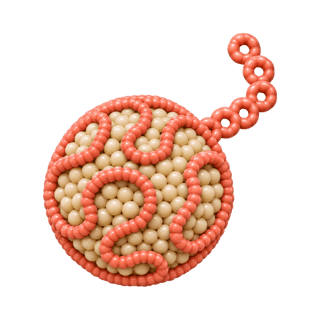
Does ApoB include Lp(a)?
Yes. Lp(a) is a particle built like LDL with an extra protein strand attached, and like every particle in that family it carries exactly one ApoB, so your ApoB already counts them. It can’t tell you how many of them are Lp(a), though, so Lp(a) is still its own test. The 2026 US guideline says every adult should have it measured at least once.
What we’d do
Get Lp(a) measured once, and ask for it on the same draw as an ApoB if you can. Your ApoB tells you how many plaque-building particles you carry, and your Lp(a) tells you how many of them are a kind the guideline says is mostly set by one gene and stays stable. You need both numbers to know what you can change.
One ApoB on every particle
The guideline says ApoB “directly measures atherogenic particle number, with 1 molecule per LDL, very-low-density lipoprotein (VLDL), and Lp(a) particle”. The National Lipid Association says the liver’s form of ApoB sits on VLDL, IDL, LDL and Lp(a), and in Lp(a) a second protein, apo(a), is bonded onto that ApoB.
| Particle | ApoB on it | In your ApoB number |
|---|---|---|
| VLDL, the big triglyceride carriers | one | yes |
| IDL, a VLDL on its way to becoming LDL | one | yes |
| LDL | one | yes |
| Lp(a) | one, with apo(a) attached | yes |
It’s like counting every car on a road, which includes the red ones. You know the total, but not how many are red until you count those separately.
Why it’s still its own test
Lp(a) is mostly set by one gene, called LPA, and the guideline says it stays stable through life except in a few conditions, such as the menopausal transition or kidney, liver or thyroid disease. It recommends measuring it “at least once” in all adults for heart risk, and lists a level of 125 nmol/L (50 mg/dL) or more among the things that raise risk. Labs report it either as a mass in mg/dL or as a particle count in nmol/L, and the guideline says results from different assays are hard to compare, so use the same lab if you ever repeat it.
cholesterol.guide covers the rest of the Lp(a) story: what a high one means and what to do about it. For what the rest of the ApoB count is made of, see What is ApoB?.
3 sources
- Blumenthal RS, Morris PB, Gaudino M and others, 2026 ACC/AHA guideline on the management of dyslipidemia, JACC, 2026doi.org
- The same guideline, full text, Circulation, 2026api.iscpcardio.org
- Soffer DE, Marston NA, Maki KC and others, Role of apolipoprotein B in the clinical management of cardiovascular risk in adults: an Expert Clinical Consensus from the National Lipid Association, Journal of Clinical Lipidology, 2024pmc.ncbi.nlm.nih.gov