Is high ApoB genetic?
On this page
Partly. Your genes set how fast your liver pulls ApoB particles out of the blood, and about 1 in 250 to 300 people inherit familial hypercholesterolemia (FH), which slows that clearing a lot. A parent, brother or sister with a heart attack or stroke young (men before 55, women before 65) is on the 2026 US guideline’s list of things that raise your risk. Food still moves the count, whatever your genes.
What we’d do
If your ApoB is 140 or more, or heart disease came early in your family, see a doctor before you plan a diet, and ask about FH. Get an Lp(a) test once. Tell your parents, brothers, sisters and children, since the guideline says checking their cholesterol is reasonable too. Then make the same food changes anyone would, because they lower the count whatever caused it.
Why people think it’s all genes, or all food
Some people eat well, exercise and still get a high ApoB, so they decide it’s all in their genes and food can’t help. Others hear that it’s all diet and blame themselves. Both are half right, since your genes set how wide your liver’s drain is, and food changes how fast the tap runs.
What your genes do
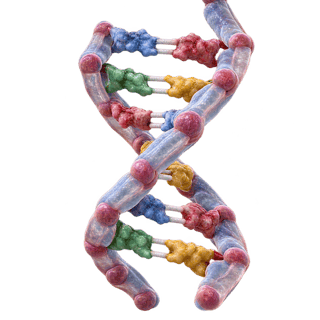
Particles leave your blood when receptors on your liver grab their ApoB and pull them in. The guideline names three genes that can cause FH. One builds the receptor (LDLR), one builds ApoB itself (APOB), and one controls how fast the receptors get broken down (PCSK9). Any of them means particles stay in the blood longer, so the count is high from birth.
The guideline says FH affects 1 in 250 to 300 people, comes with two to four times the risk of heart disease at a young age, and that as many as 90% of the people who have it haven’t been diagnosed. Its line for looking is an LDL of 190 or more, or an ApoB of 140 or more. At that level it calls for checking other causes first and then a statin at the highest dose a person tolerates.
Family history moves your goal
The guideline’s list of risk enhancers includes heart disease that came early in a parent or sibling, a higher-risk ancestry such as South Asian or Filipino, a high genetic risk score if you’ve had one, and a high Lp(a). The guideline says they can help confirm that someone’s risk is higher than the calculator shows. A higher risk band means a lower goal, under 70 at high risk instead of under 90. What should my ApoB be? has the ladder.
Lp(a): the inherited particle your ApoB already counts
Lp(a) is an LDL-like particle whose level is mostly set by your genes, and one test is usually enough for life. Each one carries one ApoB, so your ApoB already counts them. The 2026 guideline asks every adult to measure Lp(a) at least once. If you have FH, early heart disease or a high Lp(a), it recommends testing your parents, brothers, sisters and children for high Lp(a) too. Does ApoB include Lp(a)? has more, and cholesterol.guide’s What is Lp(a)? covers the test.
Test the family
When someone has FH, early heart disease or very high cholesterol, the guideline says it’s reasonable to check their first- and second-degree relatives with one cholesterol panel, starting as young as 2. For children that’s a standard panel, since ApoB isn’t part of routine testing in kids. Finding it early means years of lower numbers, and the years count. cholesterol.guide’s When it’s your genes goes through FH in detail.
Why the cause doesn’t change the fix
In a 2019 study of 654,783 people, genes that lowered ApoB cut the odds of heart disease by about the same amount per point, whether they worked through triglycerides or LDL. The count was what mattered, however it got there. So a high ApoB from your genes comes down the same way as one from your plate. Halving saturated fat took off about 6 to 7 mg/dL in a feeding trial. With FH, food rarely closes the whole gap, which is why the guideline turns to medicine there, and that decision belongs with your doctor. Should I take a statin for a high ApoB? has the case for and against.
4 sources
- Blumenthal RS, Morris PB, Gaudino M and others, 2026 ACC/AHA guideline on the management of dyslipidemia, JACC, 2026doi.org
- The same guideline, full text, Circulation, 2026api.iscpcardio.org
- Ference BA and others, Association of triglyceride-lowering LPL variants and LDL-C-lowering LDLR variants with risk of coronary heart disease, JAMA, 2019pmc.ncbi.nlm.nih.gov
- Bergeron N and others, red meat, white meat and plant protein on high and low saturated fat diets, a feeding trial in 113 adults, American Journal of Clinical Nutrition, 2019pmc.ncbi.nlm.nih.gov