How do I lower ApoB naturally?
On this page
Two changes do the most. Halve the saturated fat you eat, mostly from butter, cheese and fatty meat, and get more of your protein from beans, lentils, nuts and soy instead of meat. In a four-week feeding trial those took ApoB down about 6 to 7 and 3 to 4 mg/dL. Retest at the same lab 6 to 12 weeks later.
What we’d do
Make both changes in the first two weeks, since they’re the biggest anyone has measured for ApoB. Count chicken as meat, because it raised ApoB just as much as beef. Add psyllium or oats for the long run. If your triglycerides are high, cut alcohol and sweet drinks too. Then retest at the same lab and judge the change against the normal noise between two tests. If you’re more than about 20 points from your goal, start the food changes and book a doctor visit at the same time, rather than waiting months to find out food wasn’t enough.
If you remember three things
- Cut saturated fat toward 7% of calories. That’s about 15 g a day at 2,000 calories, and it took off 6 to 7 mg/dL.
- Swap meat for beans, lentils, nuts and soy. Chicken counts as meat. The swap took off 3 to 4 more.
- Retest at 6 to 12 weeks, same lab. A change under about 15% can be chance.
Start with a doctor instead if your ApoB is 140 or more, you’ve had a heart attack, stroke, stent or bypass, or you’re pregnant. If you take a cholesterol medicine, keep taking it and do these changes alongside it.
Why most ApoB diets go nowhere
Most people who find out their ApoB is high do the obvious things. They swap steak for chicken breast, add oatmeal, maybe a fish oil capsule, and retest three months later at a different lab. The number moves a few points, or not at all, and they decide food doesn’t work for them.
Each of those moves is the weak version. Chicken raised ApoB as much as beef in a careful trial. Oats take off about 3 points. The 2026 US guideline recommends against supplements for lowering cholesterol. And a few points is inside the normal wobble between two tests, so nobody could have told whether it worked. The plan below uses the changes trials sized for ApoB, at the doses they used, with a fair retest at the end.
The plan, week by week
- Week 0: get a starting number. ApoB, LDL and triglycerides, at the lab you’ll use again. You don’t need to fast for ApoB. For a steadier start, have two draws a few days apart and average them. Put the result in Is my ApoB high? to see your gap.
- Weeks 1 and 2: cut saturated fat toward 7% of calories. The guideline’s list of sources is red meat, butter, full-fat milk, coconut oil and palm oil. In practice, cook with olive or canola oil instead of butter, use less cheese, and choose lean cuts over fatty or processed meat.
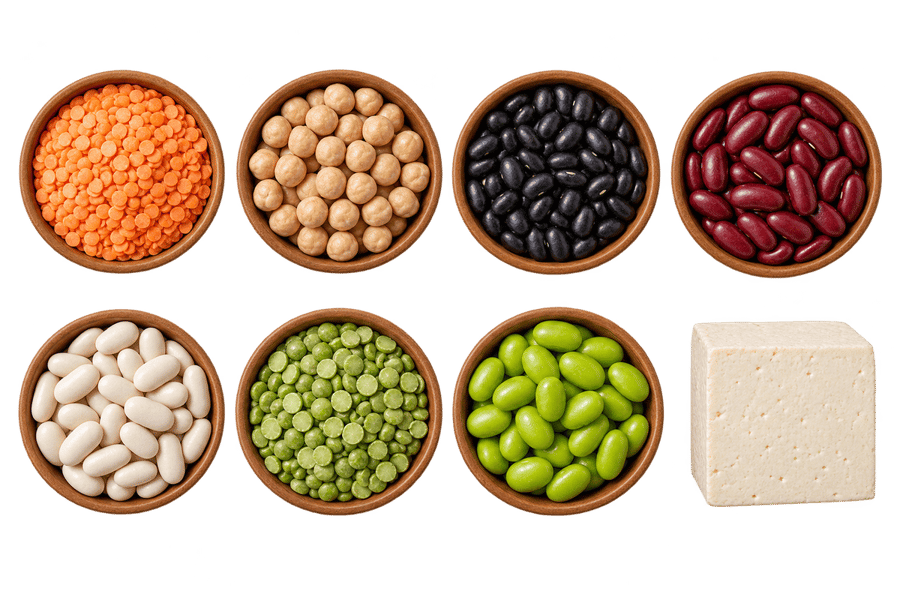
- Weeks 1 to 4: move your protein to plants. Beans, lentils, chickpeas, tofu, tempeh, edamame and nuts as the center of most meals. Chicken and turkey count as meat here.
- Weeks 2 to 4: add fiber. Build up to about 10 g of psyllium husk a day over a week or two, each dose in at least 8 oz (240 ml) of water, or eat oats or barley most days. Keep psyllium 3 hours away from digoxin, aspirin and nitrofurantoin, and ask your pharmacist about your other medicines.
- If your triglycerides are high: cut alcohol and sweet drinks. Triglycerides travel in particles that carry ApoB, and the guideline prefers ApoB or non-HDL to LDL when they’re high. cholesterol.guide has the triglyceride plan.
- Weeks 6 to 12: retest. Same lab, and two draws again if you did that at the start. Judge the change with Did my ApoB really change?
How much each change takes off
Take an ApoB of 112 mg/dL (1.12 g/L) with an unknown risk band, compared with under 90. That’s a gap of 22.
| Change | About this much off | From |
|---|---|---|
| Halve saturated fat, 14% of calories to 7% | 6 to 7 | A feeding trial of 113 adults, 4 weeks per diet |
| Psyllium, about 10 g a day | 5 | 28 trials |
| Soluble fiber of any kind | 4.5 | 181 trials |
| Beans, lentils, nuts and soy in place of meat | 3 to 4 | The same feeding trial |
| Oats or barley, about 3.5 g of beta-glucan | 3 | 58 trials |
| Losing weight | No ApoB number yet | The guideline says it lowers triglycerides more than LDL |
These come from separate trials, so don’t add them up. In the feeding trial, the two groups furthest apart, high saturated fat with red meat and low saturated fat with plant protein, were 10 points apart (73 against 63), but those were different people. A gap of 22 is more than the food changes are likely to close on their own, which is why we’d book the doctor visit alongside them. Put in your own number below.
What 7% of calories looks like
At 2,000 calories a day, 7% of your calories is about 15 g of saturated fat, and 14% is about 31 g. The meat in the feeding trial was lean and unprocessed. Most of the extra saturated fat on the high diet came from butter and full-fat dairy, so for most people the cut is mostly about butter and cheese. The nutrition label on packaged food lists saturated fat in grams, which makes the 15 g easy to count.
What a day can look like
- Breakfast: oatmeal with walnuts and berries, made with soy milk. A glass of water with psyllium stirred in.
- Lunch: a lentil soup or a bean and grain bowl dressed with olive oil.
- Dinner: tofu or tempeh stir fried in canola oil with vegetables and brown rice, or a bean chili.
- Snacks: a handful of almonds or edamame, fruit, a second dose of psyllium with water.
None of these meals are unusual. The change is mostly what sits at the center of the plate and what fat goes in the pan.
The trial behind the plan
Ronald Krauss and his team at Children’s Hospital Oakland Research Institute ran the trial between 2012 and 2016. They gave 113 healthy adults aged 21 to 65 three diets for four weeks each, with nearly all their food provided. The protein came from red meat, white meat or plants, each about 12% of calories, and half the people ate about 14% of their calories as saturated fat while the other half ate about 7%.
ApoB was 73 and 74 mg/dL on red and white meat with high saturated fat, and 70 on plants. With low saturated fat it was 67, 67 and 63. Red and white meat came out the same. Plants beat both. Cutting saturated fat took off 6 to 7 on every protein. The chicken myth has the whole story.
How to tell if it worked
Your ApoB varies about 6.4% from test to test with nothing changed, and the lab adds 5 to 6%. Together, a change has to pass about 15% to be probably real and about 23% to be almost certainly real. From 112, that’s a drop to about 95 or lower for probably real, and to about 86 or lower for a real change. A retest of 104 can’t tell you either way.
If you land in that grey zone, keep going and test again in another 6 to 8 weeks rather than giving up. Two draws averaged at each end bring the lines down to about 11% and 17%. The details are in getting tested.
If you gave it 12 weeks and your ApoB is still well over your goal, you haven’t failed. Each food change takes off a few points, and some gaps are bigger than food can close. That’s the point to talk to your doctor about medicine. Across 11 trials, LDL-lowering medicine took ApoB down 33% on average.
The fight: will this prevent a heart attack?
“These diet trials lasted four weeks and measured a blood test. None of them counted heart attacks.” That’s true. The food trials measured ApoB and stopped there.
The case that a lower ApoB protects comes from other evidence. In a study of 654,783 people, those born with genes that lowered ApoB by 10 points had about 23% lower odds of heart disease, and the benefit per point was the same whether the genes worked through triglycerides or LDL. We expect ApoB lowered by food to protect the same way per point, and your retest tells you whether yours fell.
Who this plan isn’t for
- An ApoB of 140 or more. See a doctor first. The guideline calls it severe high cholesterol and looks for a cause.
- Heart disease already. Your goal is under 60 or 70, and your cardiologist sets the plan. These food changes still help alongside it.
- Pregnancy. Cholesterol rises as a normal part of pregnancy. Talk to your midwife or doctor.
- Trouble swallowing, or a past bowel blockage. Ask your doctor before taking psyllium.
10 sources
- Bergeron N, Chiu S, Williams PT, King SM, Krauss RM, red meat, white meat and plant protein on high and low saturated fat diets, a feeding trial in 113 adults, American Journal of Clinical Nutrition, 2019pmc.ncbi.nlm.nih.gov
- Jovanovski E and others, Effect of psyllium fiber on LDL cholesterol and alternative lipid targets, non-HDL cholesterol and apolipoprotein B, American Journal of Clinical Nutrition, 2018pubmed.ncbi.nlm.nih.gov
- Ho HV and others, The effect of oat beta-glucan on LDL-cholesterol, non-HDL-cholesterol and apoB for CVD risk reduction, British Journal of Nutrition, 2016pubmed.ncbi.nlm.nih.gov
- Ghavami A and others, Soluble fiber supplementation and serum lipid profile: a systematic review and dose-response meta-analysis of 181 randomized controlled trials, Advances in Nutrition, 2023pmc.ncbi.nlm.nih.gov
- Blumenthal RS, Morris PB, Gaudino M and others, 2026 ACC/AHA guideline on the management of dyslipidemia, JACC and Circulation, 13 March 2026doi.org
- The same guideline, full text, Circulation, 2026api.iscpcardio.org
- Soffer DE, Marston NA, Maki KC and others, Role of apolipoprotein B in the clinical management of cardiovascular risk in adults: an Expert Clinical Consensus from the National Lipid Association, Journal of Clinical Lipidology, 2024pmc.ncbi.nlm.nih.gov
- Kafonek SD, Derby CA, Bachorik PS, Biological variability of lipoproteins and apolipoproteins in patients referred to a lipid clinic, Clinical Chemistry, 1992pubmed.ncbi.nlm.nih.gov
- Ference BA and others, Association of triglyceride-lowering LPL variants and LDL-C-lowering LDLR variants with risk of coronary heart disease, JAMA, 2019pmc.ncbi.nlm.nih.gov
- MedlinePlus, Psyllium, US National Library of Medicinemedlineplus.gov