Where can I get an ApoB test?
On this page
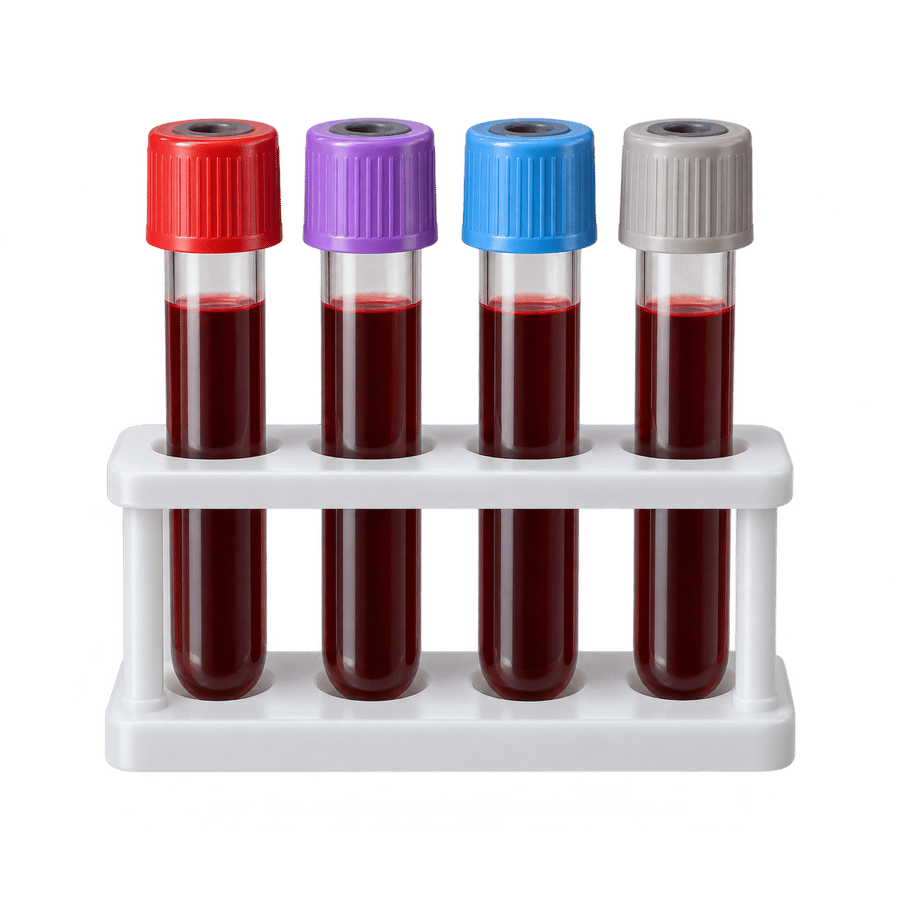
ApoB isn’t part of the standard cholesterol panel, so ask your doctor to add it to your next blood draw, or use a kit you take at home and mail back. ApoB itself doesn’t change after a meal, so a lab draw doesn’t need fasting, and a home kit’s own instructions come first. Ask for the same lab next time, so your two results can be compared.
What we’d do
Ask for ApoB every time you get a cholesterol panel. It’s the same blood draw, the test is cheap for the lab to run, and it’s the number that tells you whether your LDL is hiding a high particle count. Write down which lab ran it, test before you change anything, and retest at the same lab 6 to 12 weeks after the change has held.
If you remember three things
- Ask for it by name. “Apolipoprotein B”, added to your cholesterol panel.
- No fasting. A normal meal doesn’t change ApoB.
- Same lab, every time. Two tests can differ by about 15% with nothing changed, so don’t add a lab switch on top.
Why your last panel didn’t include it
A standard cholesterol panel has four lines: total cholesterol, LDL, HDL and triglycerides. ApoB is a separate test that someone has to order. The National Lipid Association’s 2024 consensus says it’s “readily available” at the major US labs and that the cost of running it is low. It also says the test is “underutilized in clinical practice”, and that what labs charge for it can be a barrier. A Northwestern University release in 2026 gave a simpler reason. It usually means a test on top of the standard panel, so it often isn’t ordered.
How to ask for it
Ask your doctor to add “apolipoprotein B (ApoB)” to your next cholesterol panel. It comes from the same tube of blood, so it doesn’t mean a second needle. If your doctor asks why, the 2026 US guideline gives two answers.
- If you’re on cholesterol medicine: measuring ApoB once your LDL goal is met is “reasonable”, to decide whether to do more. It helps most with triglycerides over 200, diabetes or an LDL brought under 70.
- If you’re not: it “may be reasonable” to sharpen your risk, help decide whether to start treatment, and look for inherited cholesterol problems.
Testing at home
The Gyroscope home blood test measures ApoB and ApoA1, plus LDL, HDL and triglycerides, from a kit you take at home and mail back, with results in the app within a week. It’s half price with Gyroscope One (US and Canada, not New York). Tracking it in Gyroscope has the details.
What your result will look like
US labs print ApoB in mg/dL, and Canadian labs in g/L. To go from g/L to mg/dL, multiply by 100, so 0.95 g/L is 95 mg/dL (how to convert). The report will usually print a range beside it, built from the people who get tested. Your goal comes from your risk instead. It’s under 90 at borderline or intermediate risk, under 70 at high risk and under 60 after a heart attack or stroke.
- Under 60 very high risk
- Under 70 high risk
- Under 90 borderline or intermediate risk
- 120 raises risk
- 140 severe
mg/dL over g/L. Rungs from the National Lipid Association (2024), matched to the 2026 US guideline's LDL goals. Ticks from the 2026 guideline.
Put your own number into Is my ApoB high? to see where it lands for your risk, and how it compares with untreated American adults.
Fasting, timing and the same lab
You don’t need to fast. In a 2008 study of 33,391 adults in Copenhagen, ApoB didn’t change after a normal meal, and the 2026 guideline says the test is “unaffected by fasting status”. If your panel includes triglycerides, follow what your doctor or lab asks for the rest of it.
Use the same lab each time when you can. Your ApoB varies about 6.4% between tests on its own, and the lab adds 5 to 6%. That means a change has to pass about 15% before it’s probably real. A switch between labs adds a few more points of difference you can’t separate from a real change. Cholesterol rises as a normal part of pregnancy, so compare tests from outside it if you’re tracking a change.
When to test again
- With every cholesterol panel. It’s the same draw.
- 6 to 12 weeks after a food change has held. Sooner than 4 weeks won’t tell you much.
- 4 to 12 weeks after a medicine starts or changes, the window the guideline uses, then every 6 to 12 months.
Did my ApoB really change? tells you whether the difference between two results is bigger than the normal wobble.
Like counting boxes on a delivery truck
A standard panel weighs the delivery. It tells you how much cholesterol is on board. ApoB counts the boxes, one per particle. Most of the time a heavier load means more boxes. But a delivery of many half-empty boxes weighs the same as a few full ones, and it’s the number of boxes that clogs the loading dock. That’s the case your LDL can miss and your ApoB catches.
When to see a doctor
Book a visit, whatever any plan says, if any of these apply:
- Your ApoB is 140 or more, or your LDL is 190 or more. The guideline calls both severe high cholesterol.
- You’ve had a heart attack, stroke, stent or bypass. Your goal is under 60 or 70, and your cardiologist sets the plan.
- You have diabetes and you’re 40 or older.
- A parent, brother or sister had a heart attack or stroke young, before 55 in men or 65 in women.
Chest pain or pressure means calling 911.
6 sources
- Soffer DE, Marston NA, Maki KC and others, Role of apolipoprotein B in the clinical management of cardiovascular risk in adults: an Expert Clinical Consensus from the National Lipid Association, Journal of Clinical Lipidology, 2024pmc.ncbi.nlm.nih.gov
- Blumenthal RS, Morris PB, Gaudino M and others, 2026 ACC/AHA guideline on the management of dyslipidemia, JACC and Circulation, 13 March 2026doi.org
- The same guideline, full text, Circulation, 2026api.iscpcardio.org
- Langsted A, Freiberg JJ, Nordestgaard BG, Fasting and nonfasting lipid levels, Circulation, 2008pubmed.ncbi.nlm.nih.gov
- Kafonek SD, Derby CA, Bachorik PS, Biological variability of lipoproteins and apolipoproteins in patients referred to a lipid clinic, Clinical Chemistry, 1992pubmed.ncbi.nlm.nih.gov
- Northwestern University, Little-used cholesterol test could prevent more heart attacks, strokes, news release, 8 April 2026news.northwestern.edu