
What is ApoB?
On this page
ApoB (apolipoprotein B) is a protein, and every particle that can carry cholesterol into an artery wall wears exactly one, which means an ApoB test counts those particles. The LDL on a standard cholesterol panel tells you how much cholesterol is inside the LDL particles, but not how many there are.
What we’d do
Ask for ApoB with your next cholesterol test. You don’t need to fast. When it disagrees with your LDL, go by the ApoB, because heart attacks follow the number of particles. Then judge it against the goal for your risk, which for most adults is under 90 mg/dL, and not against the range printed on the report.
Why there are two numbers
Cholesterol doesn’t float loose in your blood. It rides inside particles your liver makes, called VLDL, IDL, LDL and Lp(a). The 2026 US guideline says ApoB “directly measures atherogenic particle number, with 1 molecule per LDL, very-low-density lipoprotein (VLDL), and Lp(a) particle”. LDL cholesterol, it says, “reflects the cholesterol mass within LDL particles rather than the number”.
Think of trucks on a road. LDL tells you how much cargo is on the road. ApoB counts the trucks. Most of the time more cargo means more trucks. But the same cargo can be spread over a few full trucks or a lot of half-empty ones, and it’s the trucks that crash into the wall.
How much the count tells you
In UK Biobank, researchers looked at 293,876 adults with no heart disease. At an LDL of about 130, ApoB ran anywhere from 86 to 109 mg/dL. Over 10 years, about 7 in 100 of the people with a high ApoB for that LDL had a heart attack, stroke or similar event, against about 4 in 100 with a low one.
A second study gives the reason. Some people are born with gene variants that lower their triglycerides, and others with variants that lower their LDL. In 654,783 people, both kinds cut the odds of heart disease by about 23% for every 10 mg/dL lower ApoB, so what counted was the number of particles, whichever route got there.
What the test is like
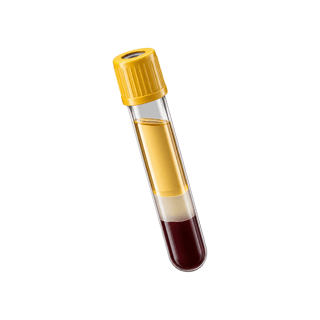
It’s an ordinary blood test your doctor can add when you have your panel. The guideline says the test is “standardized and unaffected by fasting status”. The National Lipid Association says it runs on the same lab machines as a standard panel, and most tests land within 4 mg/dL of the true value.
US reports print it in mg/dL. If yours says g/L, multiply by 100, so 0.90 g/L is 90 mg/dL (how to convert).
Where to go next
Put your number in the checker below to see it against each goal. If it doesn’t match your LDL, why is my ApoB high if my LDL is normal? explains the split, and what should my ApoB be? gives the goals. For the rest of the panel, LDL and non-HDL, cholesterol.guide has it.
6 sources
- Blumenthal RS, Morris PB, Gaudino M and others, 2026 ACC/AHA guideline on the management of dyslipidemia, JACC, 2026doi.org
- The same guideline, full text, Circulation, 2026api.iscpcardio.org
- Soffer DE, Marston NA, Maki KC and others, Role of apolipoprotein B in the clinical management of cardiovascular risk in adults: an Expert Clinical Consensus from the National Lipid Association, Journal of Clinical Lipidology, 2024pmc.ncbi.nlm.nih.gov
- Sniderman AD and others, Discordance among apoB, non-high-density lipoprotein cholesterol, and triglycerides: implications for cardiovascular prevention, European Heart Journal, 2024pmc.ncbi.nlm.nih.gov
- Ference BA and others, Association of triglyceride-lowering LPL variants and LDL-C-lowering LDLR variants with risk of coronary heart disease, JAMA, 2019pubmed.ncbi.nlm.nih.gov
- Marston NA and others, Association of apolipoprotein B-containing lipoproteins and risk of myocardial infarction in individuals with and without atherosclerosis, JAMA Cardiology, 2022pubmed.ncbi.nlm.nih.gov