Can I lower ApoB without medication?
On this page
This page sizes what food can do so you can talk to your doctor with numbers. It never tells you to start or stop a medicine.
Often, if your gap is small. Food changes took ApoB down about 6 to 7 mg/dL for a saturated fat cut and 3 to 4 more for swapping meat for beans and soy, in a feeding trial. So if you’re within about 10 points of your goal, food can plausibly close it, and up to about 20 a retest will tell you. Past that, or at 140 or more, after a heart attack or stroke, or with diabetes from age 40, medicine is the conversation to have with your doctor.
What we’d do
Work out your gap: your ApoB minus your goal. If you want to and can, start the natural way, with the saturated fat cut and the protein swap, since they help whatever else you do. Retest at the same lab after 6 to 12 weeks. If you’re still more than about 20 points over, or you’re in one of the groups the guideline offers a statin to, take both numbers to your doctor. If you already take a medicine, keep taking it and bring your questions to the person who prescribed it.
Why it feels like two camps
Online, high ApoB gets two kinds of advice. One side says a statin is the only answer. The other says the right diet fixes anything. Both skip the number that decides it, which is how far you are from your goal. A person 8 points over and a person 45 points over have the same diagnosis on paper and very different choices.
How far food goes
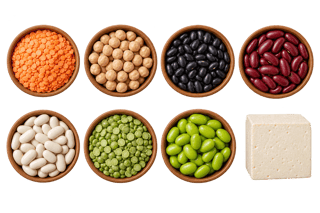
The best measure comes from one feeding trial in Oakland, California, published in 2019. Its 113 adults ate three diets for four weeks each, with nearly all their food provided. Halving saturated fat, from about 14% of calories to about 7%, lowered ApoB about 6 to 7 mg/dL. Swapping red or white meat for beans, nuts, grains and soy took off about 3 to 4 more. Across the trial’s two groups, the high saturated fat diet with red meat and the low saturated fat diet with plant protein ended about 10 points apart.
Fiber helps a little on top. Soluble fiber took off about 4.5 mg/dL across 181 trials, and psyllium about 5 across 28. Trials tested each change on its own, and together they usually add up to less than the sum. For most people, food adds up to somewhere around 10 points, a bit more with a big diet change.
The pale band is about 17 points: how far two tests at 110 can land apart with nothing changed. Each food change sits inside it on one retest, so judge food over several. The changes overlap, so they never add up to the sum of the bars.
Medicine works on a different scale. Across 11 trials of LDL-lowering medicine, ApoB fell 33% on average. At 110 that’s about 36 points, about three times what the food changes did in trials.
Your gap decides most of it
| Your gap to your goal | What usually happens |
|---|---|
| Under your goal | Nothing to fix. Retest with your next panel |
| Up to about 7 points | One food change is about that size. Start it and retest |
| About 8 to 20 points | The two food changes together may close it, and a retest at the same lab will tell |
| More than about 20 points | Food alone rarely closes this much in trials. It’s a conversation to have with your doctor |
| ApoB of 140 or more | A doctor visit first, whatever your risk |
These are the same lines Is my ApoB high? uses when it shows your gap.
Like a leak under the sink
A slow drip you can fix yourself with a wrench. A burst pipe needs a plumber, and you’d still turn the water off while you wait. Food is the wrench. It works on every leak, and for a small one it can be all you need. For a big one it’s what you do alongside the plumber.
Who the guideline offers medicine to anyway
In every group the 2026 US guideline starts with healthy habits. But for some people it recommends a statin whatever their diet, because their risk is high enough that the benefit is clear:
- A heart attack, stroke, stent or bypass. A high-intensity statin, started or continued, up to age 75 (class 1, the strongest).
- An LDL of 190 or more, or an ApoB of 140 or more. After checking for other causes, a statin at the highest dose a person tolerates (class 1).
- Diabetes, aged 40 to 75. A moderate statin “regardless of estimated 10-year ASCVD risk” (class 1).
- A 10-year risk of 5% or more on the PREVENT calculator. At 5 to under 10%, at least a moderate statin is recommended, after a talk about the benefits and risks.
At a borderline risk of 3 to under 5%, the guideline leaves it to you and your doctor. At low risk, under 3%, it recommends healthy habits, with a statin only for an LDL of 160 to 189 or a high 30-year risk. Should I take a statin for a high ApoB? has the case for and against.
Three people, three answers
- ApoB 98, borderline risk. The goal is under 90, so the gap is 8. The two food changes could close it, and a retest in 6 to 12 weeks will say.
- ApoB 112, risk unknown. Against under 90 the gap is 22. Start the food changes and ask the doctor for a PREVENT score, since the answer depends on the band.
- ApoB 145. Over the 140 line, so the doctor comes first, whatever the risk. Food still helps, but it isn’t the first step.
How to know if it worked
Two ApoB tests can differ by about 15% with nothing changed, since your body varies about 6.4% and the lab adds 5 to 6%. At 110 that’s about 17 points, more than any single food change. So judge food over a retest or two, at the same lab, and use Did my ApoB really change? on the results.
What nobody knows yet
The food trials ran for weeks and measured ApoB, not heart attacks. Gene studies suggest a lower count protects the same way however it got lower, but nobody has run a long trial of diet against a statin for people with a high ApoB. The twelve week plan puts the food changes in order, and What lowers ApoB, sized has every change with its source.
If you take a cholesterol medicine, your prescriber decides any change. Never stop one on your own.
7 sources
- Bergeron N, Chiu S, Williams PT, King SM, Krauss RM, red meat, white meat and plant protein on high and low saturated fat diets, a feeding trial in 113 adults, American Journal of Clinical Nutrition, 2019pmc.ncbi.nlm.nih.gov
- Ghavami A and others, Soluble fiber supplementation and serum lipid profile: a systematic review and dose-response meta-analysis of 181 randomized controlled trials, Advances in Nutrition, 2023pmc.ncbi.nlm.nih.gov
- Jovanovski E and others, Effect of psyllium fiber on LDL cholesterol and alternative lipid targets, American Journal of Clinical Nutrition, 2018pubmed.ncbi.nlm.nih.gov
- Soffer DE, Marston NA, Maki KC and others, Role of apolipoprotein B in the clinical management of cardiovascular risk in adults: an Expert Clinical Consensus from the National Lipid Association, Journal of Clinical Lipidology, 2024pmc.ncbi.nlm.nih.gov
- Blumenthal RS, Morris PB, Gaudino M and others, 2026 ACC/AHA guideline on the management of dyslipidemia, JACC, 2026doi.org
- The same guideline, full text, Circulation, 2026api.iscpcardio.org
- Kafonek SD, Derby CA, Bachorik PS, Biological variability of lipoproteins and apolipoproteins in patients referred to a lipid clinic, Clinical Chemistry, 1992pubmed.ncbi.nlm.nih.gov